S2 Arena
A full simulator for the ARC Championship (ARCC), built with CU Robotics. It generates rulebook arenas, inspects robots, and referees matches automatically. Six robots can play one match, and each robot can run the team's real firmware against a MuJoCo plant. People drive those robots from a browser.
Driving Sim runs on a host machine, so it is only live while that host is running a match.
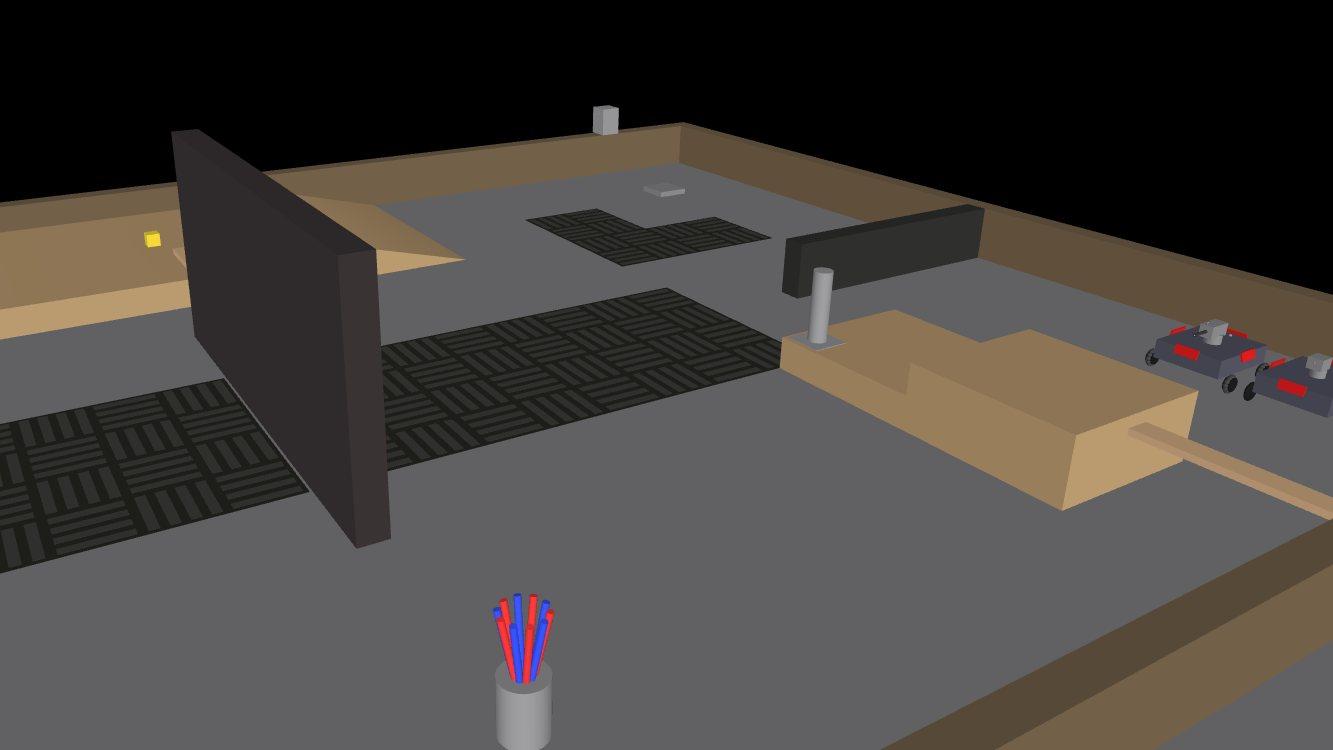
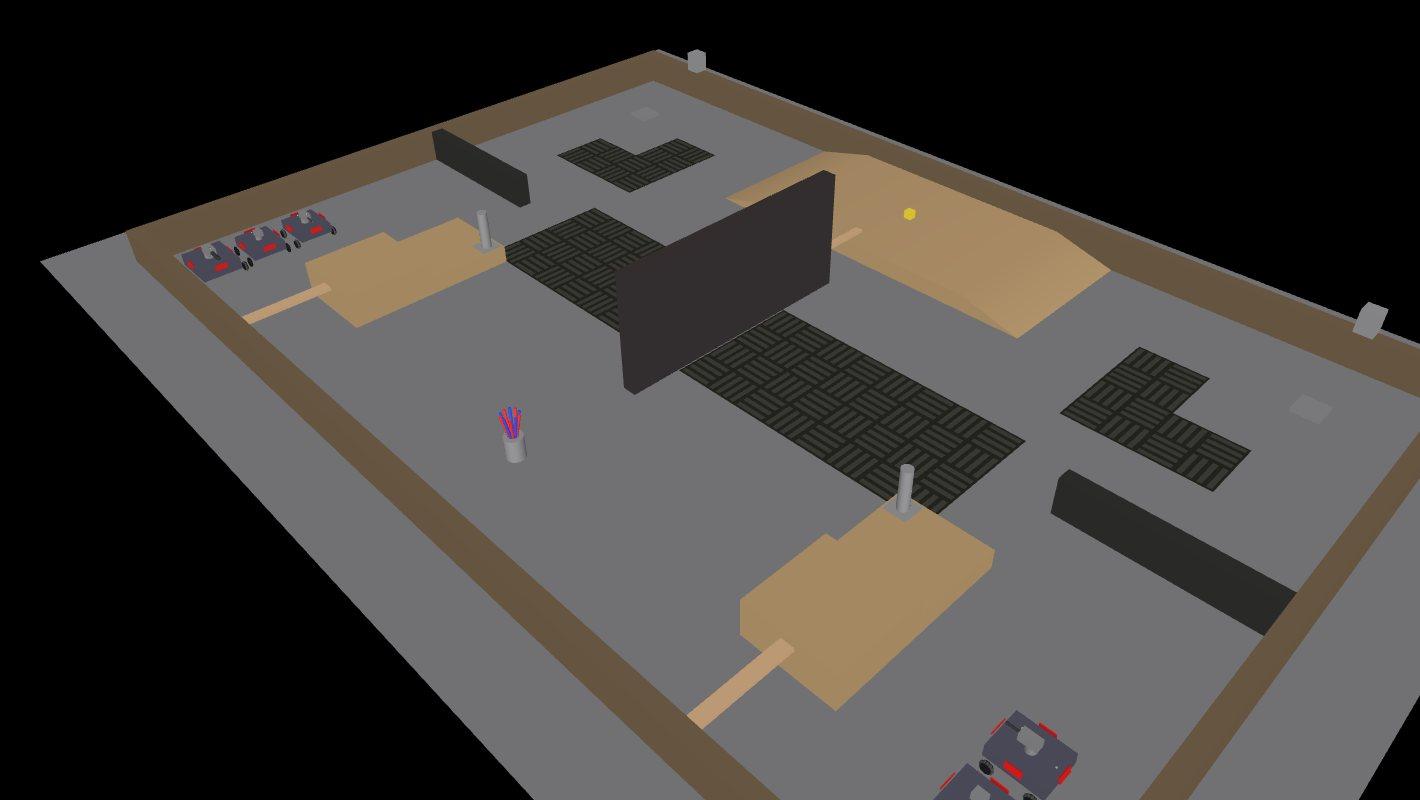
The 2026-27 3v3 field, composed by the arena generator and drawn with the MuJoCo renderer. The robots are the generic reference robots.
- 2
- seasons of rules, keyed as data
- 1 kHz
- physics step, with a 100 Hz control tick
- 6
- robots per match, each with private firmware
- 4
- perception levels, from ground truth to images
Why we built it
ARCC is a robot combat competition. Teams build robots that fire projectiles at armor plates. A referee system on each robot measures hits, power, barrel heat and muzzle speed, and it can cut power when a robot breaks a limit. A team gets very little time on a real field, and a broken robot stops all testing.
The first simulator drove one robot with real firmware. Then the team needed full matches, so that drivers could practice and strategy could be tested. When the Season 2 manuals came out, the rules changed. We decided to build the simulator so that a new season is new data, not an edit to old code. The goal has three parts:
- Inspect any robot against the building rules, as event Inspection does.
- Referee any robot at runtime: chassis power, barrel heat, muzzle speed, armor hits, HP, penalties, autonomy and ammunition.
- Play on arenas built to the dimensions in the manuals: 2026-27 3v3 and 1v1, and 2025-26 3v3.
System architecture
The match server has one rule at its center: the world does not know the referee. The physics world reports events. The referee turns events into decisions. The game mode connects the two. So each part can be tested alone, and the same referee can run any season. The core is C++20 with Python bindings.
We copy the real referee system
Teams do not write the referee. The organizers lend each team the hardware, and team code can only read it through a serial port. We copy that boundary exactly. Each real module has a simulated part, so any firmware that works on a real robot can read the same data here.
| Real module | What it does | Simulated part |
|---|---|---|
| Power Management | Measures chassis power and cuts outputs on a penalty | PowerGate |
| Armor Module x4 | Detects hits and collisions on each plate | ArmorSensor |
| Speed Monitor | Measures each muzzle speed. Barrel heat comes from this | SpeedMonitor |
| Main Control | Holds robot state and gives team code the referee serial port | MainControl |
| RFID | Reads cards under zones, such as resupply | Rfid |
| Light Indicators | Team color, HP, buffs. Opponents aim at the plate lights | Lights |
Rules are data
Limits, damage, heat, victory points and durations live in YAML under rules/<season>/, and each value cites its manual section. C++ and Python load the same files. A mode is named 3v3@2025-26, so an older season stays playable with its own rules, arena and robots.
Robots are packages
A robot is a robot.yaml manifest and a model.xml. The arena has no code that is specific to our robots. Inspection reads a package and makes the static checks that event Inspection makes: weight, dimensions, armor placement, launchers, battery and supercap energy. The repo includes generic, rule-legal reference robots that come only from rulebook limits.
What it can simulate
| Area | Model |
|---|---|
| Rigid bodies | Chassis, suspension, omni and mecanum wheels, gimbal, ramps, walls and objectives, with contacts, in MuJoCo at 1 kHz. |
| Projectiles | 17 mm and 42 mm rounds with gravity and quadratic drag (midpoint RK2). Each step tests a swept sphere against plate faces and a ray against other geometry. Dispersion, speed spread and resting rounds are included. |
| Electrical power | A DC motor model per motor: I = (V - k_e w) / R, clipped to the current limit. It includes copper loss and regeneration. The referee integrates the limit minus measured power into the 60 J buffer. A cut makes the wheels coast. |
| Referee | HP, armor damage, barrel heat, over-speed, over-power, respawn, penalties, resupply, autonomy, objectives and victory points. |
| Perception | Four levels, chosen per slot. The server sends each robot only what that level allows (Figure 2). |
| Timing | Lockstep for training and tests, so that the same seed and commands give the same bytes. Real time for external hardware: late commands are held and counted, as on a real field. |
Firmware in the loop and the robot plant
Most robot simulators use an ideal controller. We run the team's real firmware instead. The estimator, reference governor, controllers and safety state all run as they do on the robot. Only the hardware layer changes: stubs replace CAN and sensors, and a virtual clock replaces the hardware clock. No firmware source is copied. It compiles from a git submodule, so the simulator always runs the firmware the team really uses.
Firmware was never written to run many times in one process. It keeps process-wide globals. So we split the robot into two libraries with a plain C boundary. Each robot loads a private copy of the firmware library, and a fault in one robot leaves the others alone.
referee bytesrm_fw_*motor
commands
FirmwareInstance copies the shared library to a unique temp file, opens it with dlopen(RTLD_NOW | RTLD_LOCAL), unlinks the file and resolves each rm_fw_* symbol. Each copy has its own globals. A safety fault in firmware becomes a FirmwareFault in Python, and a reset starts a new episode.
The robot configuration uses the same path as the real robot. A small Rust tool turns the team's robot YAML files into the packets that the robot computer sends to firmware. In the arena, this is the Level M interface: each tick the firmware reads simulated sensors and referee bytes, and it returns motor commands. A browser driver or RL policy sends Level K intent into that same stack, so a person drives a robot with the real control loops.
Plant fidelity
The plant uses omni wheels on sprung corners, a motor model with a back-EMF current envelope, and gimbal numbers from CAD and measured replays. Each number has a recorded source, and we keep a numbered list of assumptions. We mark each value as measured, from CAD, from a data sheet, or a guess. This list shows where results can be trusted.
A wheel model made a large speed change. We replaced rings of roller spheres with one ellipsoid on each axle, carried by one free roller hinge that resets each step. A 3v3 match has a fifth of the bodies and contacts. With a projectile grid and work on hot paths, matches run about 2.3 times faster.
Driving Sim
Driving Sim is the front end. Anyone can open a link and drive a robot with no install. One server process hosts several games. A player hosts a game and gets a six-character code. Each of the six slots can be a human, a scripted bot or a policy, and empty slots become bots.
- Three transports carry the match, in order of preference: a WebRTC data channel, WebSocket, and SSE. A tunnel forwards only TCP, so the client falls back by itself.
- The server decides what each client sees. Clients get only the state their robot may know, and the viewer draws it.
- Auto-aim runs only on the server, so competition code never reaches a browser.
- Each match records to disk. Replays re-simulate from the recorded commands.
- First and third person, a spectator view, a lobby, and ranked accounts.
Open source boundary
The arena is built to be released under Apache-2.0, for other teams. The team's competition software stays private. A test fails the build if the public tree imports anything from the private side, and private values stay in one adapter folder.
Current status
- Working: 1v1 and 3v3 2026-27, and 3v3 2025-26, on the arena code, with real firmware on the plant for each robot. A full match with the team's auto-aim on both sides runs with zero plant faults.
- In progress: a simulated LiDAR sensor and localization, for the Sentry.
- Open: the Site Manual and Communication Protocol for Season 2 are not out yet, so the parts that depend on them are marked to be done.
- Stretch goals: the Drone Challenge and Dart Challenge need flight models.
The S2 Arena repo is not public yet. This page will link to it after the release.