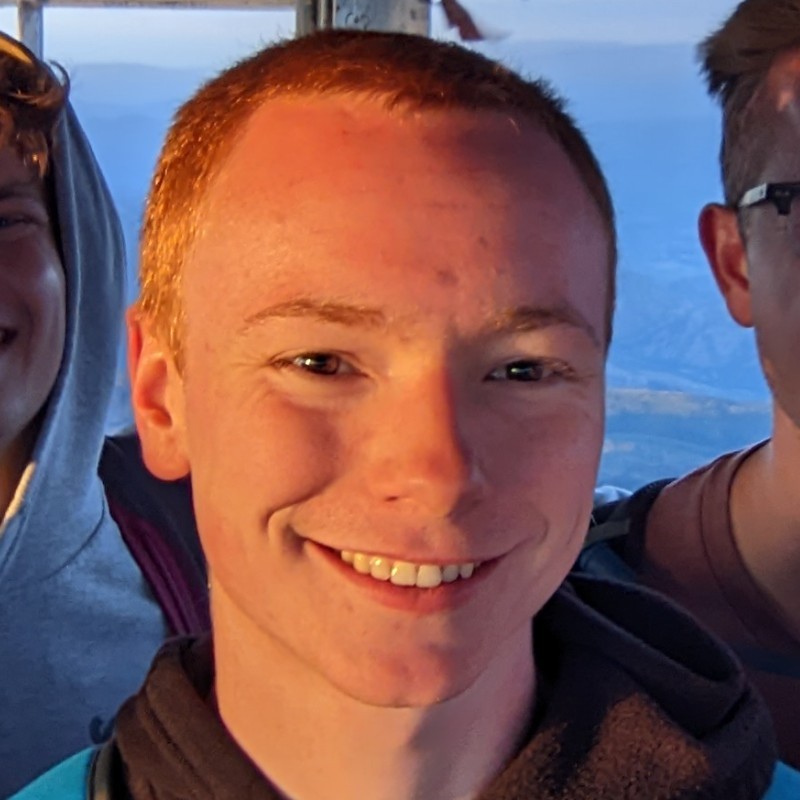
I'm Luke Phillips, an aspiring robotics researcher driven by a fascination with creating machines that navigate the world with the fluid intelligence of living systems. My path to robotics has been anything but linear—it's been shaped by years of exploring physics, mathematics, and artificial intelligence, by hands-on engineering work that taught me the gap between theory and implementation, and by a growing conviction that the most meaningful work I could do lies at the intersection of perception, learning, and control. What ultimately drew me to this field wasn't a single moment of clarity but rather a gradual recognition that robotics synthesizes everything I find compelling about science and engineering: control theory, physics, artificial intelligence, and the tangible challenge of building systems that work in the messy complexity of the real world.
My academic foundation began at the University of Utah, where I graduated in May 2024 with dual Bachelor of Science degrees in Physics and Applied Mathematics, along with a minor in Computer Science. I chose to study data science initially, however I soon switched to physics because I found it much more fun and interesting. The computational emphasis in my physics degree and my parallel study of applied mathematics gave me a strong foundation in scientific computing, numerical methods, differential equations, and the mathematical tools essential for modeling complex systems. Courses like Computing in Physics, Numerical Analysis, and Data Management for Machine Learning taught me not just the theory but the practical implementation skills necessary to translate mathematical concepts into working code. I learned to build physics simulations from first principles, implement numerical optimization algorithms, and work with large-scale scientific datasets—skills that would prove essential for robotics research.
Throughout my undergraduate years, I had a tendency to follow my curiosity wherever it led, which meant I explored a wide range of research areas before finding my focus. I worked with Dr. Kyle Dawson on the Dark Energy Spectroscopic Instrument project, analyzing massive spectral datasets to identify classification disagreements between DESI data and earlier cosmological surveys. This work taught me how to handle large-scale scientific computing, using Python libraries like Pandas and working with supercomputing resources through the Department of Energy's NERSC facility. I learned the importance of rigorous data analysis and the challenge of extracting meaningful signals from noisy, high-dimensional data—skills that translate directly to robotics perception problems. In another project, I developed a convolutional neural network to predict the mechanical properties of porous materials from cross-sectional images, generating training data through finite element analysis and implementing the complete pipeline from data generation to model training. This gave me hands-on experience with deep learning architectures and the practical challenges of training neural networks on synthetic data, an approach that's become increasingly important in robotics as researchers look for ways to generate training data through simulation.
But some of my most formative experiences came from engineering work outside the classroom. As Avionics Team Lead for the university's CubeSat Club, I led a team that built a functional telemetry ground station with tracking capabilities for UHF satellite communication. We integrated Arduino-controlled motors with signal analysis software to create a system that could autonomously track satellites as they passed overhead. This project taught me the crucial difference between theoretical understanding and practical implementation—you can know all the communication theory in the world, but until you've debugged hardware integration issues at three in the morning, soldered together antenna feeds, and figured out why your tracking algorithm is introducing a systematic pointing error, you don't really understand the system. In the university Aerospace Club, I developed a MATLAB trajectory integration program that incorporated thrust profiles, weather data, and aerodynamics to predict rocket landing points. These projects gave me experience with the full stack of robotics-adjacent engineering: sensor integration, real-time control systems, trajectory optimization, and the unglamorous but essential work of making physical systems reliable.
During my time at Utah, I also completed several projects that demonstrated my ability to work across the theoretical and practical divide. In Computing in Physics II, I built a complete physics simulation of Feynman's ratchet and pawl thought experiment from scratch, implementing the full thermodynamic model and creating animations that conclusively showed that work cannot be extracted when both chambers are at the same temperature. The project required deep understanding of statistical mechanics, careful numerical implementation to avoid introducing artifacts, and the ability to visualize complex physical processes in a way that made the underlying principles clear. In Numerical Analysis, I implemented noise reduction for grayscale images using discrete Fourier transforms, developing algorithms to identify and eliminate high-frequency components while preserving the underlying signal. In my Data Management and Machine Learning course, I explored the unconventional idea of replacing dictionary hash functions with neural networks to reduce collisions—an approach that required understanding both the computer science fundamentals of data structures and the deep learning techniques necessary to train effective models. These projects taught me to approach problems from first principles, to implement solutions efficiently, and to validate that my implementations actually worked as intended.
Looking back at my undergraduate years, I recognize that my academic record—a 3.28 GPA—doesn't fully reflect my capabilities, and I want to address this directly. I struggled with focus and study habits during those years, problems that stemmed partly from graduating high school during COVID and developing poor attendance patterns that followed me into college. I often skipped lectures, didn't allocate sufficient time for homework, and underestimated the difficulty of upper-level mathematics and physics courses. My approach was to explore everything that interested me—hence the two degrees, the minor, the three research labs, and the multiple engineering clubs—rather than to optimize my performance in any single area. But the turning point came in Physics V, a demanding course covering quantum mechanics and electromagnetism, where I completely revised my study habits and earned an A, including a perfect score on the quantum mechanics exam. This demonstrated to me that when I commit fully and apply disciplined study methods, I can excel at the highest level of undergraduate physics and mathematics.
After graduation, rather than immediately pursuing graduate school, I made the deliberate choice to join the Peace Corps. I needed perspective and maturity—I needed to step away from the constant input of mentors and advisors and discover what truly motivated me when I was completely on my own. For the past eighteen months, I've been serving as a mathematics teacher in Guinea, West Africa, teaching three classes of over seventy students each—in French, a language I learned here. I've worked with my principal to end corporal punishment and implement new discipline policies, and I've pioneered an exercise-focused teaching approach to replace the rote memorization standard that dominates education here. This experience has transformed me in ways I couldn't have anticipated. Teaching 200+ students with minimal resources, in a language I didn't speak fluently when I arrived, in a culture completely different from my own, has taught me adaptability, resourcefulness, and the ability to build systems from first principles. It's proven to me that I can commit to difficult, long-term goals and see them through even when the challenges seem overwhelming.
More importantly, the distance and perspective of Peace Corps service allowed me to finally identify what I want to dedicate my career to. During my undergraduate years, I seriously considered pursuing a physics PhD until conversations with researchers revealed aspects of academic culture that troubled me—the publish-or-perish pressure, the emphasis on career advancement over genuine intellectual exploration, the narrow specialization required to be competitive. I briefly considered data engineering for the financial security it offered, but I knew I couldn't sustain passion for work that felt fundamentally dry. I needed to find something that could hold my complete attention, something that synthesized my interests in physics, mathematics, and artificial intelligence while creating something tangible and meaningful.
That's when I discovered the field of agile autonomous systems, and everything suddenly made sense. I came across research from groups like ETH Zurich's Robotics and Perception Group, watching their demonstrations of drones navigating complex environments with animal-like agility, and I felt something click into place. Here was a field where the mathematical elegance of control theory, the empirical depth of physics, and the creative power of machine learning converged to create systems that moved through the world with a kind of intelligence that felt genuinely alive. The specific technical challenges—vision-based learning, perception algorithms that enable real-time navigation through unstructured environments, reinforcement learning and differentiable simulation for training sensorimotor policies, the sim-to-real transfer problem—felt like exactly the kind of problems I wanted to spend my career solving. I realized I had finally found work I could commit to completely, where I could focus one hundred percent of my energy without distraction or doubt.
Since that realization, I've been aggressively building my knowledge base in robotics. I'm currently working through Russ Tedrake's Underactuated Robotics course from MIT and Steven Brunton's Data-Driven Engineering materials, absorbing the fundamental concepts of robotic control, state estimation, and model-based learning. To demonstrate my understanding and commitment, I'm developing a comprehensive web-based tutorial that explains cart-pole balancing through multiple complementary approaches: PID control, LQR (Linear Quadratic Regulator), reinforcement learning, neural network policies, and trajectory optimization. Each method is accompanied by interactive simulations built with PyDrake, with all the mathematical theory explained alongside working implementations. The goal is to show not just that I can implement these algorithms, but that I understand them deeply enough to teach them to others, to explain why each approach works, where it fails, and how the different methods relate to each other. I'm also planning to complete a comprehensive C++ course and build several robotics projects in that language before beginning graduate studies, recognizing that high-performance robotics systems require proficiency in compiled languages for real-time control and sensor processing.
My technical skills now span the full stack necessary for robotics research: strong foundations in Python and MATLAB for rapid prototyping and scientific computing, growing proficiency in C++ for performance-critical implementations, experience with deep learning frameworks like PyTorch for perception and learning systems, familiarity with ROS for robot software architecture, and solid grounding in numerical optimization, computer vision, and state estimation. My background in physics gives me an intuitive understanding of dynamics and control, my mathematics training provides the theoretical tools for rigorous analysis, and my computer science work has taught me how to implement efficient, reliable software systems.
What drives me now is a clear vision of the work I want to do. I'm fascinated by the challenge of enabling robots to perceive and navigate dynamically through unstructured environments—the problem of taking raw sensory input, whether vision or other modalities, and mapping it in real-time to control commands that allow a robot to move with speed, precision, and adaptability. I want to work on vision-based robot learning with foundation models, exploring how we can leverage the recent breakthroughs in large-scale pre-trained models to give robots more robust, generalizable perception capabilities. I'm interested in agile flight and legged locomotion, in the specific technical challenges of making robots move with the fluid efficiency of biological systems. I want to work on the sim-to-real transfer problem, developing methods that allow robots to learn behaviors in simulation that transfer reliably to the physical world. These aren't abstract research interests—they're the specific technical problems I think about constantly, the challenges I want to dedicate the next phase of my life to solving.
I'm preparing now for graduate studies in robotics starting Fall 2026, targeting programs with strong research groups in perception, learning, and control for autonomous systems. I bring to this next phase a solid mathematical and computational foundation, demonstrated research ability across multiple domains, significant teaching experience that's developed my communication skills and resilience, and most importantly, complete commitment to the field of robotics. My undergraduate GPA reflects a period of unfocused exploration, but my recent trajectory—the self-directed study, the project development, the maturity gained through Peace Corps service—demonstrates the focused dedication I will bring to graduate work. I'm ready to contribute to and learn from a strong robotics research community, and I'm excited to finally begin the work I know I'm meant to do.